What a Trading Platform Is and What It Does
It is a software environment that enables users to view market data, manage accounts, and submit orders, in principle, a trading platform acts as a link between the trader and the financial world at large, thereby connecting each small decision to an exchange and its liquidity source or clearing facility. Although the features, design, and complexity of trading platforms may vary, they all provide essential support in this respect.
User Interface and Market Access
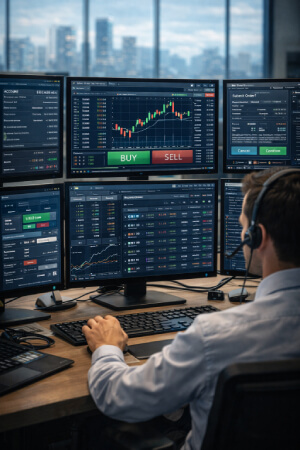
The user interface is the most visible part of a trading platform. It organizes prices, charts, order tickets, and account information into a layout designed to support fast decision-making. Some platforms prioritize minimalism, showing only essential data, while others offer dense dashboards filled with indicators and tools. The interface does not merely display information; it shapes how users interpret market movement and risk.
Market access is embedded within this interface. Platforms determine which instruments are available, from equities and currencies to derivatives and commodities. Access may vary by region, account type, or regulatory constraints. While traders often think of markets as universal, the platform defines the specific slice of the market they can actually reach.
Account Management and Controls
Trading platforms also manage user accounts, including balances, margin usage, and open positions. This layer ensures that trades comply with account limits and regulatory requirements before orders are sent for execution. Account information is updated continuously as prices move and positions fluctuate, providing a real-time picture of exposure.
Controls built into the account layer include leverage limits, margin calls, and automatic liquidation rules. These mechanisms protect both the platform operator and the user from excessive risk. Although they may feel restrictive, they are essential to maintaining system stability, especially during periods of rapid market movement.
Security and Authentication
Security is a foundational requirement for any trading platform. Authentication systems verify user identity through passwords, multi-factor methods, or biometric tools. These measures reduce the risk of unauthorized access, which could lead to financial loss or data exposure.
Order Types and the Execution Process
If you come up with a trading idea and then wish to act on it, you have to place an order. The next stages in the processing must interpret, validate, and route the order. It is a rapid yet multi-stage process that affects the final result of execution; this final outcome may cover the price and fill speed.
Market Orders and Limit Orders
Market orders instruct the platform to execute immediately at the best available price. They prioritize speed over precision, making them suitable for highly liquid markets where price differences are usually small. However, in fast-moving or thin markets, market orders can be filled at prices significantly different from those displayed moments earlier.
Limit orders, by contrast, specify a maximum or minimum price at which the trader is willing to transact. The platform places these orders into the market order book or an internal system until conditions are met. While limit orders offer price control, they carry the risk of non-execution if the market does not reach the specified level.
Advanced Order Conditions
Many platforms support advanced order types that add conditional logic to execution. Stop orders, for example, become active only when the market reaches a certain price, often used to manage risk or enter trades during momentum. Other conditions include time-based expiration or partial fills.
These advanced orders increase flexibility but also complexity. The platform must monitor market data continuously to trigger conditions accurately. Errors or delays in this monitoring can affect outcomes, which is why robust execution technology is critical for supporting such features reliably.
Routing and Liquidity Sources
After authentication, orders are sent to a market for provision of market liquidity. In accordance with platform variability, this may mean directly sending orders to an exchange, aggregating quotes from several markets or providing quality-of-matching-invented facilities. Execution speed and the ease with which an order is executed amount to be valuable part in every decision known to buying.
Diversifying in liquidity pools does not guarantee similar quality; in some cases, an exchange which the platform-partners with results in prioritized and fast trading, while in other cases it might result in cheaper trading costs- all based on various venues and speeds. For traders, a substantial part of the execution quality depends on the designs of the platform, not just market conditions.
Charting Tools and Market Visualization
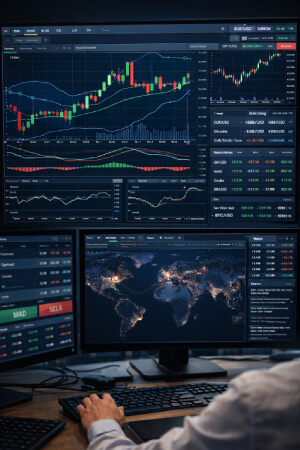
Charts translate raw price data into visual form, helping traders identify patterns, trends, and potential opportunities. Most trading platforms include charting tools as a central feature, reflecting their importance in decision-making. These tools range from basic line charts to complex, multi-indicator displays.
Timeframes and Price Representation
Trading platforms typically allow users to view price data across multiple timeframes, from seconds to years. Shorter timeframes reveal fine-grained fluctuations, while longer views highlight broader trends. Switching between these perspectives helps traders align decisions with their strategy horizon.
Price representation also varies. Candlestick charts, bar charts, and line charts each emphasize different aspects of price behavior. Platforms often support multiple formats, allowing users to choose the visual language that best suits their analytical approach.
Technical Indicators and Overlays
Technical indicators add calculated data layers to charts, such as moving averages, momentum oscillators, or volatility bands. These tools aim to extract meaning from historical prices, offering signals that may guide entries or exits. Platforms usually provide a library of indicators with customizable parameters.
Overlays and indicators can be combined in countless ways, but more is not always better. Excessive complexity can obscure rather than clarify market behavior. Effective platforms balance flexibility with usability, helping users apply tools without overwhelming the core price information.
Customization and Workspace Layouts
Customization allows traders to tailor charts and workspaces to their preferences. Platforms may support multiple chart windows, saved layouts, and color themes. These features help users maintain consistency and reduce cognitive load during active trading.
Workspace design also affects efficiency. Being able to arrange charts, order tickets, and news feeds within a single view can shorten reaction time. While customization seems cosmetic, it directly influences how comfortably and accurately traders interact with the market.
Platform Architecture and Performance
Behind every interface lies an architecture designed to handle large volumes of data and requests. Trading platforms must process price updates, user actions, and risk calculations continuously without interruption. Performance at this level determines whether a platform feels responsive or unreliable.
Latency and Speed Considerations
Latency refers to the delay between an action and its effect, such as submitting an order and receiving confirmation. In trading, even small delays can matter, particularly in fast markets. Platforms invest heavily in reducing latency through optimized code and proximity to market infrastructure.
Speed is not only about execution but also about data delivery. Real-time price feeds must update quickly and consistently to support informed decisions. Any lag or inconsistency can create confusion and undermine trust in the displayed information.
Reliability and System Uptime
Reliability is measured by how consistently a platform remains available and functional. Outages during volatile periods can prevent users from managing risk or closing positions. For this reason, platforms employ redundancy, monitoring, and failover systems to maintain uptime.
Testing and maintenance are ongoing processes. Platforms must update software, patch vulnerabilities, and adapt to market changes without disrupting service. Achieving this balance is a constant operational challenge.
Scalability and Load Management
As user numbers and trading volumes increase, platforms must scale accordingly. Load management systems distribute traffic to prevent bottlenecks during peak activity. Without effective scaling, performance can degrade precisely when demand is highest.
Scalability also supports future growth. Platforms designed with modular components can add features or markets without reengineering the entire system. This flexibility helps platforms evolve alongside changing trading behavior.
Risk Management and Compliance Features
Risk management is embedded into trading platforms at multiple levels. It ensures that individual trades and overall exposure remain within acceptable bounds. These controls protect users, platform operators, and the wider financial system from cascading failures.
Compliance requirements further shape platform behavior. Regulations influence how data is handled, how orders are executed, and how users are informed. Platforms must integrate these requirements into their design without compromising usability.
Pre-Trade and Post-Trade Controls
Pre-trade controls check orders before execution, verifying margin availability, position limits, and order validity. These checks prevent errors and excessive risk from entering the market. Although they add a small delay, they are essential for system integrity.
Post-trade controls monitor positions and account health after execution. They track unrealized gains and losses, margin usage, and exposure changes. Automated alerts and actions, such as margin calls, help manage risk dynamically as conditions evolve.
Transparency and Reporting
Platforms provide reporting tools that summarize trading activity, performance, and fees. These reports support self-assessment and regulatory transparency. Clear reporting helps users understand outcomes and identify patterns in their behavior.
Transparency also extends to execution details. Information about fill prices, timestamps, and order status allows users to evaluate execution quality. Without this visibility, it is difficult to assess whether a platform is performing as expected.
Regulatory Alignment
Regulatory alignment requires platforms to follow rules governing market access, data protection, and fair execution. These rules vary by jurisdiction but share common goals of stability and consumer protection. Platforms often build compliance checks directly into workflows to ensure consistency.
Adapting to regulatory change is an ongoing task. As rules evolve, platforms must update processes and systems while maintaining continuity for users. This adaptability is a key measure of long-term platform viability.
Where Technology Meets Market Reality
Trading platforms represent an intersection of technology, regulation, and human evaluation. Far beyond being mere tools, they dictate access, execution, and exposure to information, experientially shaping the dynamics of markets at an individual level.
Understanding how these elements interlock does not necessarily equate to trading success, but it does provide a context in which to read the provided materials. Traders who understand the technology of execution and design of the platform are in a much better position to navigate markets with a degree of consciousness as distinct from assumption.